This guest blog explores how Z-Wave Long Range and Aliro work together to create a seamless smart apartment experience in multifamily buildings through smart access, automation, and connected building technology.
It’s 6:15 on a Tuesday evening. Sarah pulls into the parking garage of her apartment building, grocery bags in the back seat, laptop bag over her shoulder, and her phone buzzing with a reminder that her favorite show starts in forty-five minutes. What happens next is a story the smart home industry has been trying to tell for years — and we’re finally ready to tell it right.
As Sarah approaches the building’s front entrance, she doesn’t reach for a fob, a key card, or even her phone. The Aliro-enabled reader at the door recognizes her credentials stored securely in her mobile wallet and the door unlocks as she walks up. No tap required. She’s through the lobby and into the elevator without breaking stride.
This is the promise of Aliro — the new open standard for smart access that puts your keys in your phone’s wallet, right next to your credit cards and boarding passes. For residents, it means one less thing to carry and one less thing to lose. For property managers, it means no more programming fobs, no more rekeying locks, and a modern access experience that today’s renters expect. Behind the scenes, it’s Z-Wave that makes this possible — the property manager uses the building’s Z-Wave network to configure each lock to recognize and accept the right credentials, turning what used to be a manual, door-by-door process into a centrally managed operation.
But getting through the front door is only the beginning.
Sarah reaches her floor. As she walks down the hallway, the corridor lighting — connected via Z-Wave Long Range — has already adjusted to evening mode, dimming to a warm glow that saves the building energy while keeping the space welcoming. The property management system knows the building’s occupancy patterns and optimizes lighting, ventilation, and common area systems accordingly. Z-Wave Long Range makes this possible at building scale, connecting hundreds of devices across multiple floors on a single network with range that legacy wireless protocols simply can’t match.
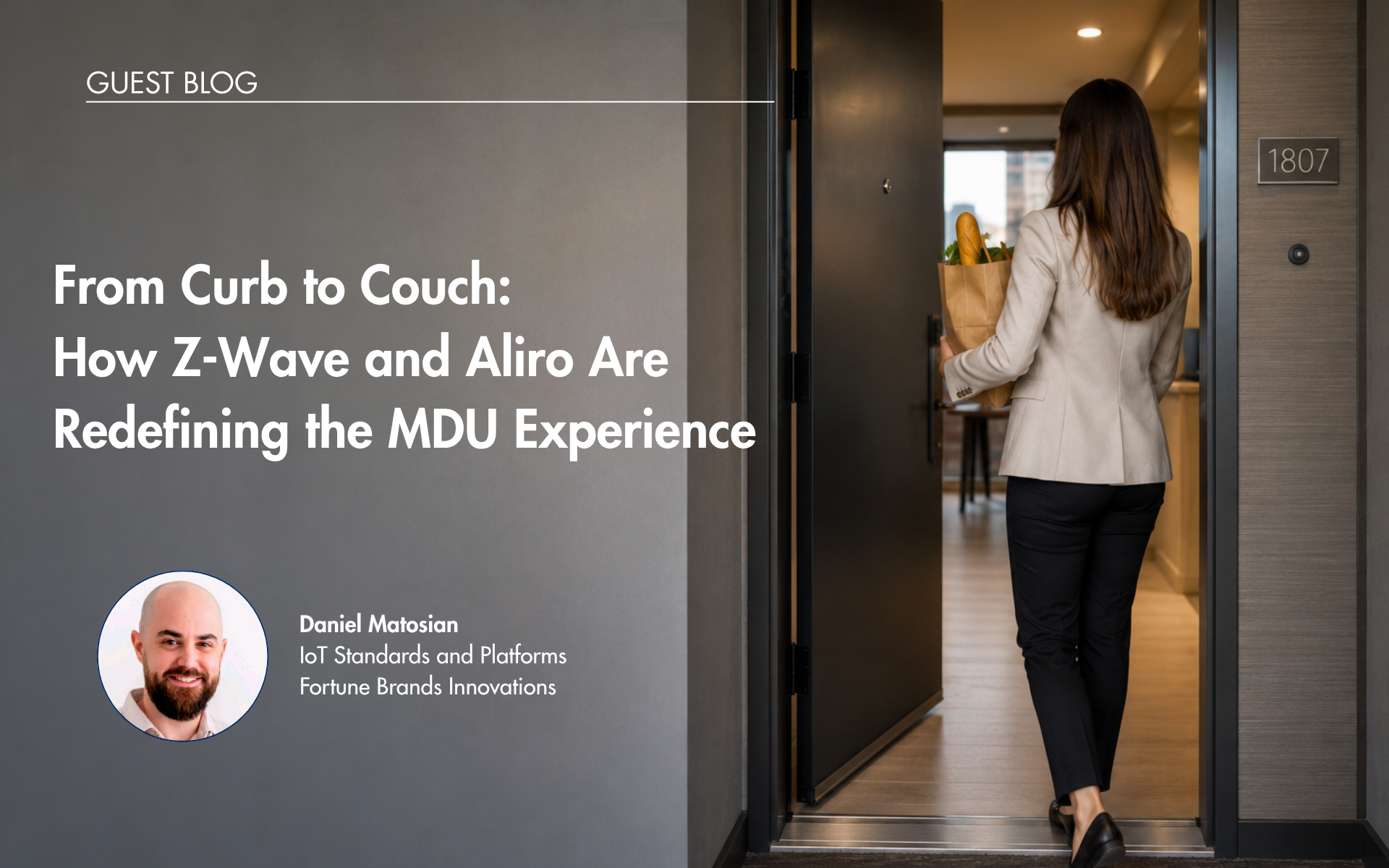
She arrives at her apartment door. Again, Aliro handles the credential exchange seamlessly — a quick approach and she’s inside. The smart lock sends a Z-Wave notification to her smart home hub confirming she’s home, and that single event sets everything in motion.
The entryway lights come on. The thermostat, which had been holding an energy-saving setback temperature all day, starts warming the apartment to her preferred 72 degrees. The smart blinds tilt open to catch the last of the evening light. Her favorite playlist starts playing softly through the connected speaker in the living room. By the time Sarah sets down the grocery bags and drops onto the couch, her apartment has already adapted to her presence — no voice commands, no app, no switches.
This is the curb-to-couch experience.
It sounds futuristic, but every piece of this technology exists today. What makes it work isn’t any single product — it’s the interoperability between standards that were designed to complement each other. Aliro handles identity and access. Z-Wave handles the automation, sensing, and device communication that make a building truly intelligent. Together, they create a seamless thread from the moment a resident arrives at the property to the moment they settle in at home.
For property developers and managers, this isn’t just about resident satisfaction — though that alone drives retention and justifies premium rents. It’s about operational efficiency. Z-Wave Long Range’s ability to cover an entire building from a central point dramatically reduces infrastructure costs compared to running wired solutions or deploying dozens of wireless hubs per floor. Leak sensors in every unit, smart thermostats that prevent energy waste in vacant apartments, hallway lighting that responds to real occupancy — these aren’t nice-to-haves anymore. They’re table stakes for modern multifamily construction.
And with Aliro, access management becomes software instead of hardware. New resident moving in? Their access credentials are provisioned to their phone before they pick up the keys — because there are no keys. Lease ended? Access is revoked instantly. No locksmith, no front desk visit, no security gaps. Z-Wave is the connective tissue that makes this work at scale — every lock in the building is reachable over the Z-Wave network, so credential policies can be pushed, updated, or revoked centrally rather than one door at a time. The same standard works at the front gate, the parking garage, the gym, the package room, and the apartment door. One standard, one credential, every door.
Fortune Brands has been building toward this vision across our portfolio. Our Yale smart locks already support Z-Wave Long Range, and we’re actively working to bring Aliro support to our multifamily product line. We believe the future of the connected building isn’t about choosing between protocols — it’s about choosing the right protocol for each job and making them work together invisibly.
The smart home industry spent years selling individual smart devices — a connected lock here, a smart thermostat there. But residents don’t think in protocols or product categories. They think in experiences. They want to come home and have the building just work. With Z-Wave Long Range providing the backbone and Aliro handling the keys, we’re finally able to deliver on that promise — not as a concept, but as a deployable reality. From curb to couch, every step is seamless, and every system is connected.
Sarah’s already watching her show. She never thought about any of it.
That’s the point.
About the Author
Daniel Matosian is a systems architect and engineering leader specializing in smart home connectivity, interoperability, and IoT ecosystem design. With more than 15 years of experience, he focuses on bridging hardware, connectivity standards, and user experience to create scalable, secure, and seamlessly connected smart home solutions. Daniel serves as a Board Alternate representative for Fortune Brands Innovations within the Z-Wave Alliance, Connectivity Standards Alliance (CSA), and Thread Group, where he works to advance technologies including Z-Wave, Matter, and Thread. His expertise spans IoT strategy, connectivity standards, embedded systems, and cross-platform smart home architecture, with a passion for building “a smart home that actually works.”
