For IoT and smart device OEMs, the manufacturing decision that determines your launch date isn’t volume capacity — it’s protocol fluency.
In the IoT landscape, being first to market is often the difference between category leadership and irrelevance. Most OEMs evaluate contract manufacturers on unit economics and volume capacity. But for residential smart home and commercial automation devices, the real bottleneck may be protocol engineering, compliance testing, and certification pathways.
When designing and launching a Z-Wave-enabled device, a manufacturing partner with Z-Wave protocol expertise is essential, as it can directly impact whether you meet your launch schedule or face delays due to failed certification rounds.
Why Does Z-Wave Protocol Experience Matter to Your Product Timeline?
Z-Wave products need to be engineered and validated correctly from the beginning. The protocol’s interoperability and certification requirements leave little room for guesswork.
A contract manufacturer with Z-Wave experience understands mesh network behavior, interoperability testing, and RF calibration as second nature. That knowledge shortens your prototyping and pre-compliance phases. When your partner’s engineers already know Z-Wave and its frameworks, firmware-hardware integration is seamless and certification surprises become far less likely.
Compliance shouldn’t be a hurdle you clear at the very end.
A partner already deep in the Z-Wave ecosystem can help identify issues earlier and reduce the risk of months of rework that might be missed by others.
Why Should Your Contract Manufacturer Be Involved Early in New Product Introduction (NPI)?
A great manufacturer does a lot more than just assemble parts once the design is done. They show up early in the New Product Introduction (NPI) phase. This is the development journey where a single design choice can either pave the way for a smooth launch or bake in a headache that doesn’t show up until testing, production or even when your product is already in your customers’ hands.
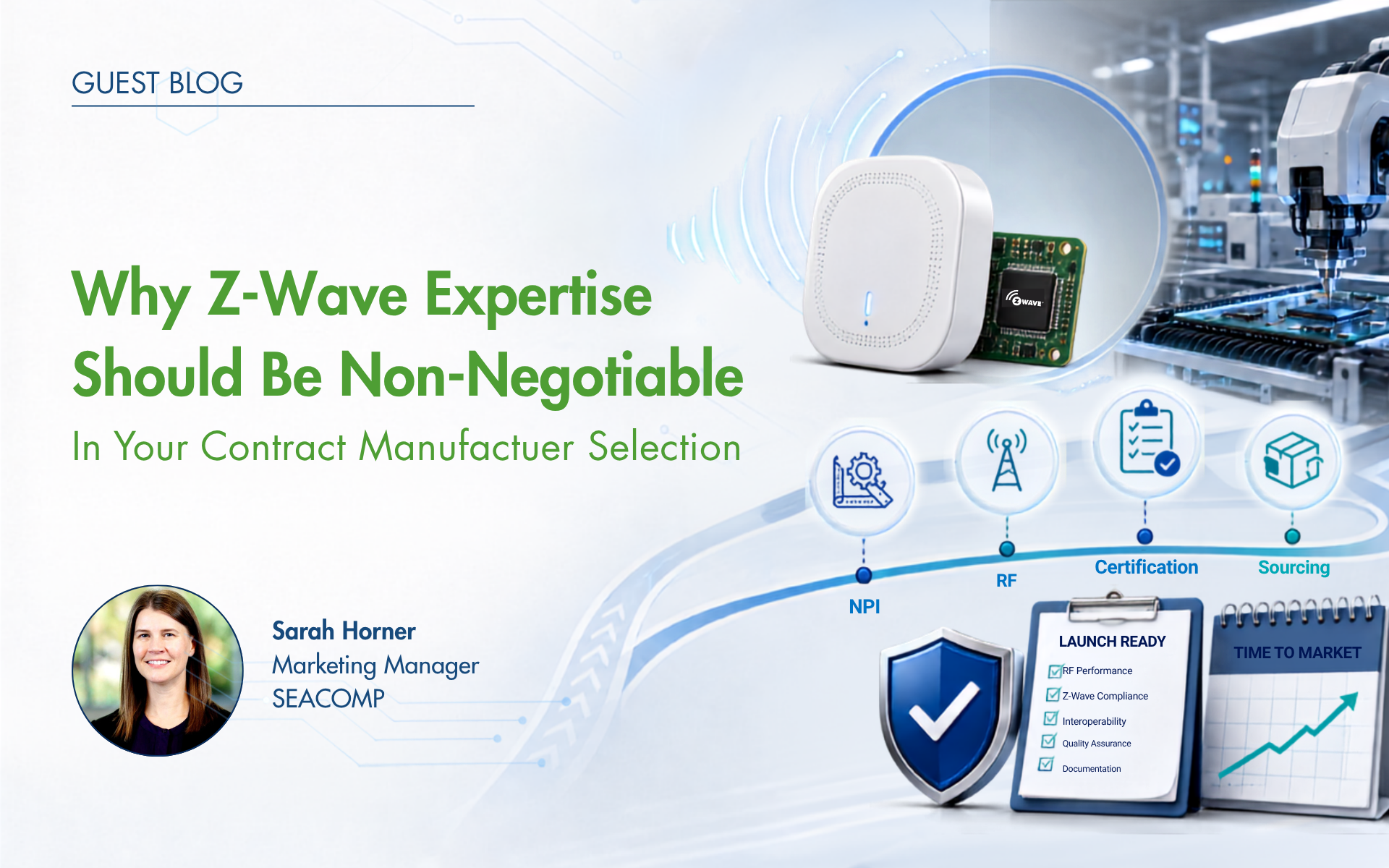
This early involvement is where Z-Wave expertise really matters. A Contract Manufacturer fluent in the protocol can flag antenna placement and RF layout issues during Design for Manufacturability (DFM) review, the earliest design and pre-production stage, well before tooling is locked. They can catch power budget conflicts that would otherwise only appear during interoperability testing. And lastly, a contract manufacturer that acts like a partner can advise on component selection based on what’s actually sourceable and within your product launch timeline, a necessary foresight given that supply chain challenges and long lead times are the current industry norm.
When NPI is a collaboration rather than just a hand-off, you catch the flaws that lead to failed certifications and field returns. Evaluate a manufacturer the same way you would a co-developer: look for how early they want to get involved and how well they can turn a prototype into a reliable, shippable product.
How can Protocol Expertise Help Reduce Certification Risk?
Technical skill is great, but it has to be backed by discipline. ISO 9001 for manufacturers is proof that their factory has the systems in place to keep quality consistent. That’s what keeps your devices running reliably for years instead of failing a few months after they’re installed.
If you’re working on anything related to health or safety — like eldercare sensors or emergency systems — an ISO 13485 certified manufacturer is a must. Even for non-medical devices, the traceability and rigorous risk management of ISO 13485 certification provide a significant advantage in ensuring consistent quality across your supply chain.
What Should You Look for in a Z-Wave-Ready Contract Manufacturer?
✓ Documented Z-Wave Protocol Experience
✓ Early NPI Involvement
✓ RD and wireless engineering expertise
✓ Provides Component Sourcing Guidance
✓ ISO 9001 Certification
✓ ISO 13485 Certification (if health/safety-adjacent devices)
✓ An Active Member of the Z-Wave Alliance
Why does the Right Contract Manufacturer Pay Off at Launch?
Choosing a contract manufacturer for your Z-Wave device is really about minimizing surprises. The most successful companies don’t just source for the lowest price per unit. They look for a partner who understands their technology, engages early, and has the quality systems to handle growth.
By prioritizing Z-Wave protocol expertise in your manufacturing partner, you can reduce the risk of redesign, retesting, certification delays, and production issues — and give your product a more predictable path from prototype to launch.
The question isn’t simply whether a manufacturer can build your device.
It’s whether they understand what it takes to build, test, certify, and repeatedly manufacture a reliable Z-Wave device.
About the Author
Sarah Horner is the marketing manager at SEACOMP, helping OEMs discover how SEACOMP’s expertise and resources can help them bring products to market successfully.
SEACOMP is a contract electronics manufacturer with facilities in Mexico and China, specializing in USMCA-compliant production for North American hardware companies. As a member of the Z-Wave Alliance, SEACOMP brings native protocol expertise to smart home and commercial automation OEMs — from early NPI through volume production.
Learn more at www.seacomp.com.