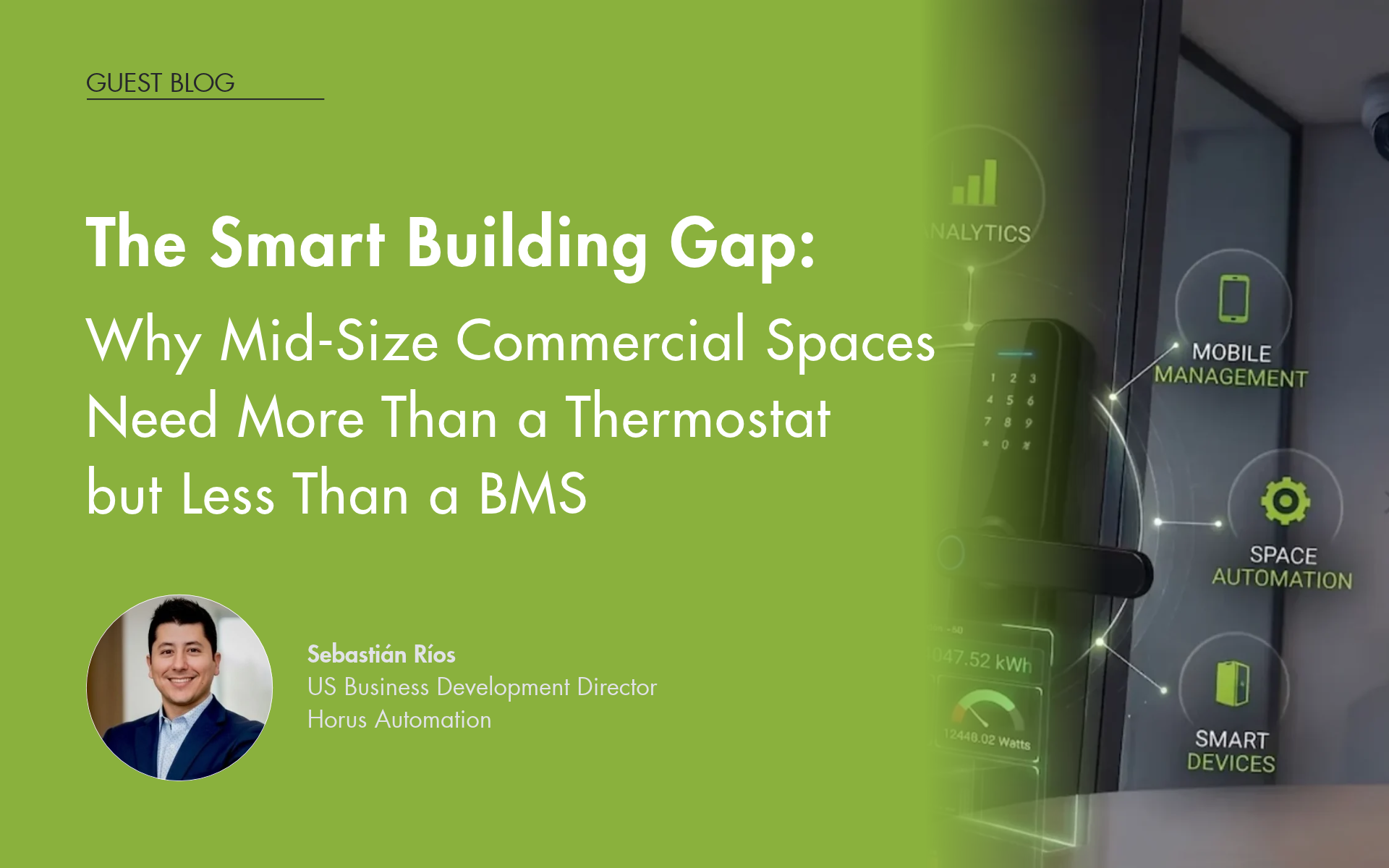
Discover how Z-Wave bridges the gap between consumer smart home devices and costly building management systems, delivering scalable, energy-efficient automation for mid-size commercial buildings.
After enough conversations with hotel owners, school principals, office managers, and retail store operators, I started noticing the same problem. The details changed, but the frustration did not. Their buildings were too large and complex for smart home gadgets, yet none were ready for a six-figure automation contract. They were stuck in the middle, and nobody in the industry seemed to notice.
The Smart Building Gap: Too Complex for Consumer Devices, Too Small for a Building Management System (BMS)
That middle is bigger than most people realize: commercial buildings in the 10,000 to 30,000 sq. ft. range. Boutique hotels, clinics, mid-size offices, retail stores, and convenience stores. They carry real utility bills, but the tools available sit at two extremes: a smart thermostat built for a house, and a complete system built for a hospital. I call that space between them the smart building gap.
A smart thermostat is good at what it was built for: a house, an individual’s or family’s schedule, one or two stories, and one HVAC unit. Install one (or a few) in a 15,000 sq. ft. hotel with thirty rooms, a lobby, and a pool deck, and it falls apart fast. It may, at best, manage a few zones, but it cannot coordinate lighting across common areas or tell you which floor or room is wasting power. Owners who try to address this with more consumer devices end up with a drawer full of hubs, five apps, and no energy data worth checking.
Traditional building automation systems (BAS) do real work, don’t get me wrong. They earn their place in large commercial and institutional buildings, with dedicated wiring, proprietary controllers, and a facilities team to run them. For a building that size, installation typically runs $20,000 to $150,000 upfront, plus an annual maintenance contract. That is money a hospital or a campus can plan for. A boutique hotel usually cannot, not because the system is inadequate, but because it was never built for a building that size.
Why Z-Wave Makes Sense for Mid-Size Commercial Buildings
Z-Wave is built for that size. As a wireless mesh protocol, it eliminates the need for dedicated wiring, so there is no major construction work, and most installations can be completed without shutting down the building. An owner can start with climate control in occupied rooms and expand later into lighting, unit access control, metering, and occupancy sensing as budget allows. The network gets stronger as it grows, as each powered, mesh-capable device acts as a repeater. The Z-Wave 800-Series also supports Z-Wave Long Range (ZWLR) for larger sites while maintaining compatibility with older devices. Z-Wave is also an open standard, so owners are not locked into a single manufacturer. That adds up to a professional-grade automation for buildings a full BMS was never sized to serve.
Real-World Building Automation and Energy Savings
What I am bringing to the U.S. market now is built on installations Horus has already completed in Colombia: multi-zone climate control, occupancy-based automation, central energy monitoring, and unit access control without replacing the existing door hardware. I do not open with a full retrofit. I start with the areas where savings are easiest to prove and then expand.
Once building owners can see real energy data, something shifts. They stop guessing which systems are wasting power and start making decisions based on actual numbers. That shift alone, in the Colombian projects this model is built on, has supported 15 to 30% reductions in energy costs, right after basic automation rules were applied.
The industry has talked about enterprise-grade and consumer-grade solutions for years. The buildings in between, a large share of the U.S. commercial building stock, have been left out of that conversation. Z-Wave fills that space. If you have outgrown your Nest Thermostat and a full BMS does not make sense, this is the technology sized for the building you own.
That is the building I look for now. Too big for a thermostat, but too small for a six-figure contract. Ready for something in the middle.
About the Author
Sebastián Ríos is Partner & US Business Development Director at Horus Automation, where he leads the US launch of its Colombian-engineered line of Z-Wave hardware and building energy efficiency technology. He has spent a decade in Smart Home, PropTech, and Access Control, building channel and distribution programs for connected hardware companies. At Level Home (dba Dwelo Smart Apartments) he built the multifamily access control channel program and expanded the installer network to nationwide coverage. At Ezlo Innovation he managed the global Z-Wave distributor network. He began his career in procurement and financial analysis, and is comfortable working through the economics of a project. He works across Z-Wave, Zigbee, BLE, and access control, and conducts business in English, Spanish, and Portuguese. He is based in Greenville, South Carolina.